
The Boardroom Case for Circular IT: Why Asset Lifecycle Strategy Is Now a CEO Decision
For a long time, what happened to a server, a storage array, or a batch of enterprise software licenses after they left production was treated as an operational footnote — a task for procurement or IT operations to tidy up at the end of a refresh cycle. That assumption no longer holds. Across Europe, the lifecycle of IT infrastructure has quietly moved from the server room to the boardroom, and the organisations that recognise this shift early are the ones that will turn a compliance obligation into a competitive advantage.
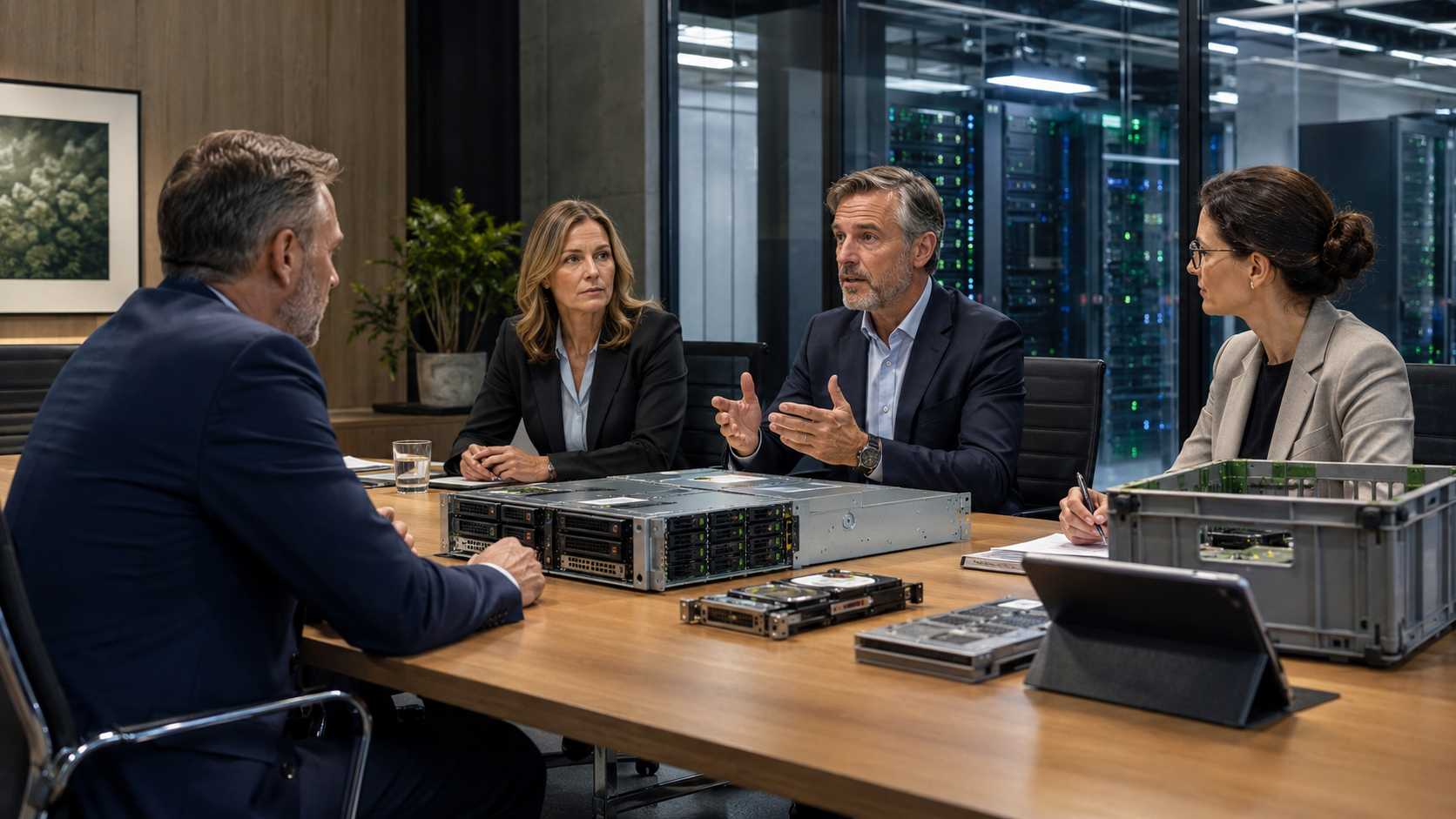
Why this is no longer an operational question?
Three forces are converging to make IT asset lifecycle strategy a CEO- and CIO-level concern.
The first is regulatory. The EU's Corporate Sustainability Reporting Directive (CSRD) and the underlying European Sustainability Reporting Standards (ESRS) now require a growing number of companies to report on resource use, circularity, and waste — not as a voluntary sustainability gesture, but as audited, board-signed disclosure. IT hardware, often overlooked in early sustainability strategies, sits squarely inside scope: it is manufactured with significant embedded carbon and critical raw materials, and its disposal or reuse has a measurable, reportable impact.
The second is financial. IT infrastructure is one of the largest recurring capital outlays for most mid-to-large organisations, yet it is frequently the least optimised from a total-value perspective. Assets are depreciated to zero, decommissioned, and either warehoused indefinitely or destroyed — value that could have been recovered simply disappears from the balance sheet. In a period where capital efficiency is under scrutiny from every board, that is no longer a trivial leakage.
The third is risk. Retired IT assets carry data, and data carries liability. How an organisation handles the physical and software lifecycle of its infrastructure is now inseparable from how it manages information security and regulatory exposure under GDPR and sector-specific rules. A weak asset lifecycle strategy is, in practice, a weak data governance strategy.
From cost centre to value stream
The traditional mental model treats IT hardware as a depreciating cost: buy it, use it, write it off, dispose of it. A circular model treats the same infrastructure as a value stream that can be actively managed across its full life — acquisition, deployment, extension, redeployment, and responsible market re-entry.
This is not an abstract idea. Enterprise-grade storage, networking equipment, and even software licenses retain substantial residual value on secondary markets, particularly when they are decommissioned in a structured, well-documented way rather than as an afterthought. Organisations that build circularity into their IT strategy from the start — rather than bolting it on at disposal — consistently capture more of that value, reduce the total cost of ownership of their infrastructure, and materially improve their sustainability reporting position at the same time.
The reframing matters because it changes who owns the decision. A cost-centre view of IT disposal belongs to operations. A value-stream view of IT lifecycle belongs to the executive team, because it touches capital planning, risk management, and public disclosure simultaneously.
What this means for governance
For a CEO or CIO, the practical implication is that IT asset lifecycle management deserves the same governance attention as any other material business process. That means:
Visibility. Boards should be able to answer a simple question — what happens to our infrastructure when it is retired, and what value or risk does that create — with the same confidence they answer questions about revenue or headcount. In many organisations today, that question cannot be answered without a scramble across IT operations, procurement, and facilities.
Ownership. Someone at senior level needs to own the end-to-end lifecycle policy, not just the procurement decision at the start. Without clear ownership, circularity initiatives tend to stall at pilot stage, generating good intentions but no measurable outcome.
Integration with reporting. As ESRS-aligned disclosure becomes standard, IT asset circularity metrics — reuse rates, resource recovery, extended service life — need to feed into the same reporting infrastructure as the rest of the organisation's sustainability data, not sit in a separate spreadsheet maintained by a single engineer.
The competitive dimension
There is also an upside case that is easy to underweight. Investors, insurers, and increasingly customers are beginning to treat resource efficiency as a proxy for operational discipline. An organisation that can demonstrate a mature, well-governed approach to IT circularity is signalling something broader about how it manages risk and capital more generally. Conversely, an organisation that cannot answer basic questions about its IT asset disposal practices invites scrutiny it does not need, particularly as due diligence processes — from procurement audits to M&A — increasingly probe sustainability and data-handling practices as a matter of course.
There is a genuine strategic opportunity here for organisations willing to move first. Circular IT strategy, done well, reduces cost, reduces regulatory exposure, and improves the sustainability profile the market is already asking about. Done poorly — or not at all — it becomes a liability that surfaces at the worst possible moment: during an audit, a due diligence process, or a public disclosure cycle.
Where to start
This does not require an overnight transformation. The organisations making the most progress are typically starting with three questions at executive level:
First, do we have a clear, current inventory of what IT infrastructure and software licensing we hold, and what its expected retirement timeline looks like? Second, do we have a defined policy — not just informal practice — for how assets are decommissioned, and does that policy address both data security and value recovery? Third, is someone accountable for reporting on the outcomes of that policy to the board, in language that aligns with our broader sustainability disclosures?
Answering these questions honestly is often uncomfortable, because for many organisations the answer is "not really." But that discomfort is the starting point for a strategy that turns a previously invisible operational process into a source of measurable financial and reputational value — and that is precisely the kind of decision that belongs at CEO and CIO level, not buried three layers down in an IT operations manual.
The organisations that treat IT lifecycle strategy as a genuine boardroom topic today will be the ones setting the standard their peers are measured against tomorrow, as circularity reporting matures from a competitive differentiator into a baseline expectation.