
Data Sovereignty Meets Data Disposal: Rethinking Information Security Beyond the Firewall
Most information security strategy is built around a simple mental picture: data flows into the organisation, lives inside protected systems, and is defended by firewalls, access controls, and monitoring for as long as it is in active use. It is a picture built around the front door. It says almost nothing about the back door — what happens to that same data when the hardware carrying it reaches the end of its working life and leaves the organisation entirely.
For most CEOs and CIOs, that back door receives a fraction of the governance attention given to the front. That asymmetry is a genuine strategic vulnerability, and it is one that European regulation is now making considerably harder to ignore.
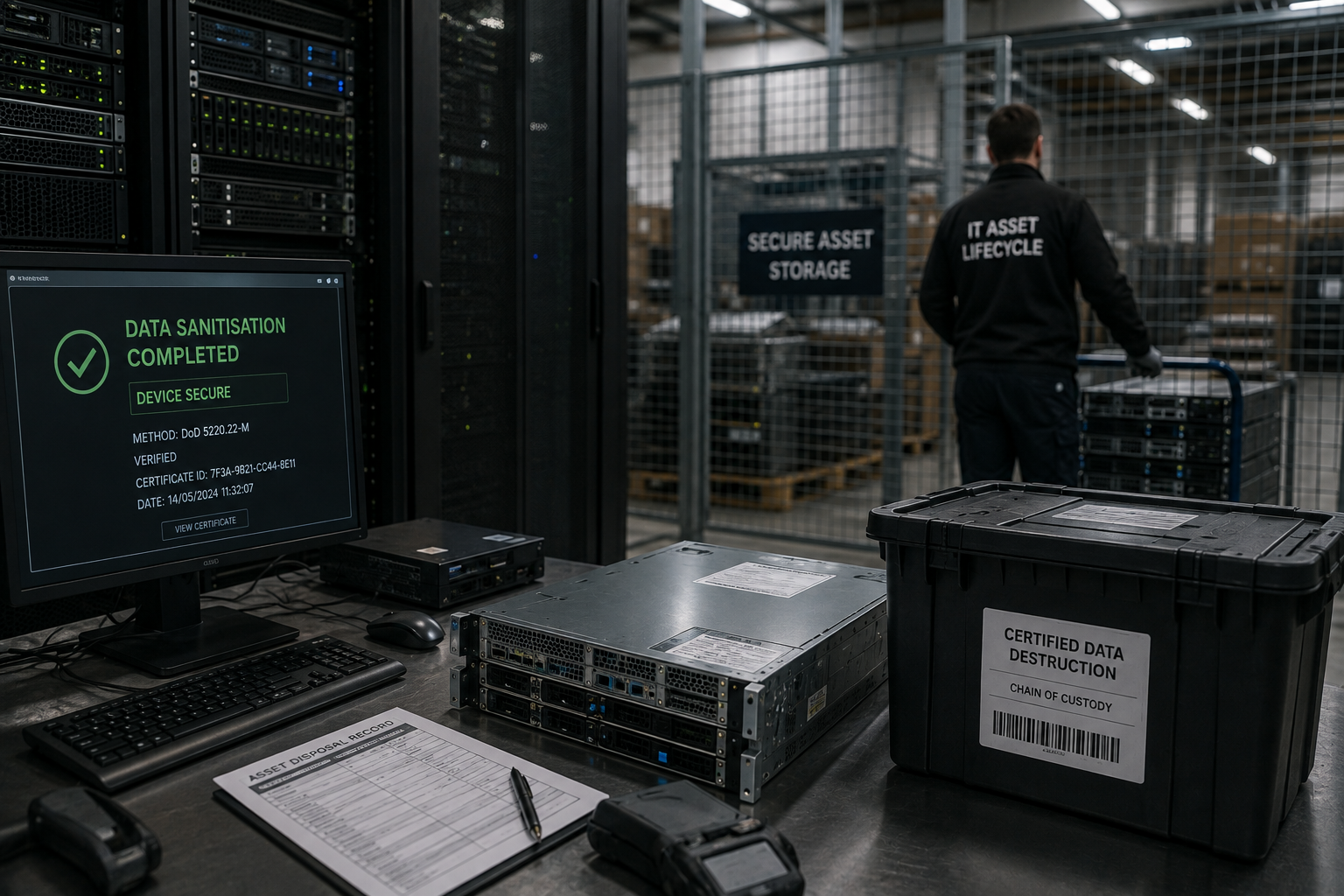
The blind spot in plain terms
Every server, storage array, laptop, and network device that is retired from active use has, in most cases, carried sensitive data at some point in its life — customer records, financial data, intellectual property, credentials, internal communications. The assumption inside many organisations is that this risk ends once the device is decommissioned and physically removed from the network. In practice, the risk often intensifies at exactly that point, because decommissioned hardware frequently moves outside the tight operational controls that governed it while in active use.
This matters because data protection obligations under GDPR do not end when a device is switched off. The obligation to protect personal data follows the data itself, regardless of whether it sits on a production server or a decommissioned drive sitting in a facilities cupboard awaiting disposal.
A data breach originating from improperly wiped or improperly tracked retired hardware is treated, correctly, with the same seriousness as a breach originating from an active system — and regulators, auditors, and increasingly customers are aware of this even when internal risk registers are not.
Why this is a strategic question, not an IT-operations question
There is a natural instinct to treat asset disposal as a logistics detail — something that happens after the interesting security decisions have already been made. That instinct undersells the risk in three specific ways.
First, scale. Over a multi-year infrastructure refresh cycle, a mid-to-large organisation will decommission a very large number of devices, often in batches, often under time pressure to clear space or meet a lease return deadline. Each of those devices is a discrete point of potential data exposure, and the aggregate risk across a full estate is not small.
Second, chain of custody. Once hardware leaves the building — whether to a recycler, a reseller, a leasing company, or simply into storage awaiting a decision — the organisation's ability to control what happens to the data on it drops sharply unless a deliberate, documented process is in place. Verbal assurances from a disposal vendor are not evidence; they are a liability waiting to be discovered during an incident investigation.
Third, timing. Security incidents originating from retired hardware often surface long after the event — sometimes years later, when a drive resurfaces on a secondary market or a device is found improperly disposed of. This creates a distinctive risk profile: the exposure is created at decommissioning, but the consequence can land at an unpredictable and often reputationally damaging moment, well after the people involved in the original decision have moved on.
The governance gap
Ask most executive teams whether they have confidence in their organisation's network perimeter security, and you will get a considered answer, usually backed by investment and regular review. Ask the same executive team whether they have equivalent confidence in what happens to data-bearing hardware at end of life, and the answer is frequently far less assured — often a shrug toward IT operations or facilities, with no clear evidence trail behind it.
This gap exists because data disposal has traditionally sat outside the normal security governance conversation. It doesn't show up in penetration testing. It rarely appears on a CISO's dashboard. It's often contracted out to whichever vendor offered the most convenient collection service, with limited due diligence on what actually happens after collection.
None of this reflects a lack of concern — it reflects the fact that this risk has simply not been framed, historically, as a security topic at all.
What a mature approach looks like
Closing this gap does not require new technology. It requires treating end-of-life data handling with the same governance discipline already applied to active systems.
That starts with documented process, not informal practice: a defined, written policy for what happens to any device once it leaves production, covering data sanitisation standard, verification, and evidence retention. It continues with verifiable evidence: certificates of data destruction or sanitisation that can be produced on demand, tied to a specific asset, not a general assurance from a vendor that "everything is handled securely." And it requires vendor accountability: any third party handling decommissioned hardware — whether for recycling, resale, or destruction — should be subject to the same due diligence rigour applied to any other processor handling sensitive data, because under GDPR, that is precisely what they are.
There is also a strategic decision embedded here that deserves board-level visibility: the choice between destruction and responsible resale is not purely an environmental or financial one. A well-governed resale process, with verified data sanitisation and a documented chain of custody, can be more secure — not less — than an informal destruction process with weak evidence trails. The two goals, security and circularity, are not in tension when the underlying process is built properly; they reinforce each other.
The board-level question worth asking
For any CEO or CIO, a useful diagnostic is simple: if a regulator, auditor, or journalist asked tomorrow what evidence the organisation holds proving that data was properly removed from every device retired in the last two years, could a credible answer be produced within a day? For most organisations today, honestly, it could not.
That is the real measure of maturity in this area — not the strength of the firewall, but the strength of the process governing what happens after the data-bearing hardware walks out the door. As regulatory scrutiny of data lifecycle management continues to tighten across the EU, closing this blind spot is no longer a nice-to-have refinement to an already strong security posture. It is, for many organisations, the single largest unaddressed gap in an otherwise mature information security strategy.